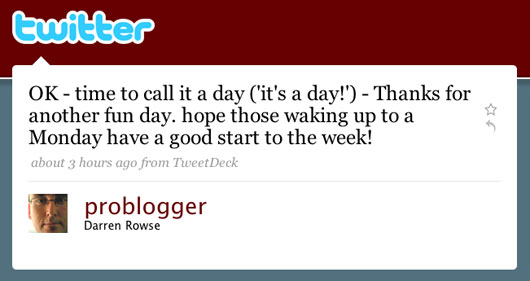
In November 2008, Darren Rowse — the blogger behind ProBlogger and Digital Photography School — launched a small site called TwiTip. It was a blog about Twitter. Not about social media broadly, not about microblogging as a concept, but specifically about how to use Twitter well.
The original idea came from a place most bloggers will recognize: Rowse had been skeptical of Twitter, dismissed it as a distraction, then finally gave it a real shot in late 2007. Within hours, he saw its potential. Within months, he was writing about it on ProBlogger. By February 2008, he’d registered TwiTip.com — and then let it sit in what he called the “one day when I get some time” basket.
That basket is familiar to anyone who’s ever bought a domain on impulse. But Rowse eventually realized what all of us figure out sooner or later: if you wait for the perfect moment, you’ll never start. TwiTip launched over a weekend, from concept to live in under 48 hours, and pulled nearly 5,000 visits on day one.
The site worked. Comments poured in. RSS subscribers climbed quickly. In an interview with Blog Herald shortly after launch, Rowse was characteristically measured about the early success — surprised by the scale, but clear-eyed about why it happened. He’d leveraged two existing audiences: ProBlogger’s readership and his own Twitter following, which at the time numbered around 13,000.
It was a textbook niche blog launch. And it’s also a story with an ending that’s worth studying more closely than the beginning.
What happened next
TwiTip ran for a few years as a modest part of Rowse’s portfolio. It never became a flagship. It served its purpose during a period when Twitter was still novel enough that people genuinely needed guidance on how to use it — how to write tweets, how to build a following, how to integrate the platform with a blogging strategy.
But the landscape shifted. Twitter matured. What once required a dedicated blog to explain became common knowledge. The audience for “Twitter tips” naturally shrank as the platform became second nature to its users.
Meanwhile, the broader ecosystem around Rowse also changed. b5media, the blog network Rowse co-founded, was acquired by Alloy Digital in April 2012 — but not before going through rounds of layoffs, pay cuts, and a CEO change that spoke to the fragility of even well-funded blog networks. In 2010, b5media abruptly shut down its entire entertainment network, leaving more than 50 bloggers without work.
And Twitter itself? It was rebranded to X on July 23, 2023, and its domain name changed from twitter.com to x.com in May 2024, after Elon Musk’s acquisition in late 2022. The TwiTip.com domain is now operated by an unrelated party, running AI-driven tool reviews for X growth.
As for Rowse, no new content appears to have been posted to ProBlogger since June 2024. A post on X from April 2024 revealed he’s returned to church ministry — a role he held before launching ProBlogger over twenty years ago. His X bio now reads: “Pastor, 20+ yrs blogging at @digitalps + @problogger, dad, husband.”
It’s a quiet arc. And I think it holds more for bloggers than any of the tactical advice TwiTip once offered.
The platform dependency trap
When Rowse launched TwiTip, he described Twitter as a “dictionary, encyclopedia, fact checker and idea bank — all rolled into one.” He called it his watercooler, his brand-building outpost, his antidote to the loneliness of working from home.
All of that was true — in 2008. None of it was permanent.
This is the fundamental risk of building content around a specific platform. The platform changes, and your content becomes a time capsule. Twitter became X. Its culture shifted. Its user base fragmented across Threads, Bluesky, and Mastodon. The advice Rowse published about growing a Twitter following in 2009 isn’t just outdated — it belongs to a platform that no longer exists in its original form.
And this pattern isn’t unique to Twitter. Bloggers who built their strategy around Google+ watched it disappear entirely. Those who optimized for Facebook organic reach saw it throttled to near-zero. Orbit Media’s 2025 survey notes that “attracting visitors from search” has spiked as a challenge for content marketers, as AI overviews and declining click-through rates reshape how Google surfaces content.
The lesson isn’t to ignore platforms. It’s to be careful about building on them versus building with them.
What Rowse actually got right
The more interesting part of the TwiTip story isn’t the blog itself. It’s the principle underneath it.
In the original 2008 interview, Rowse talked about the concept of “homebases and outposts.” His blogs were his homebases — the properties he owned and controlled. Twitter and other social media were outposts: places he showed up to connect, but that ultimately pointed people back to his home base.

That distinction proved to be one of the most durable ideas in digital publishing. And in 2026, it’s more relevant than ever.
Recent data backs this up. A 2025 creator economy report found that creators who own their audience — meaning they have email addresses for a significant portion of followers — are 2.7 times more likely to earn $31,000 or more than those who are fully platform-dependent. The creators who built on rented land — relying solely on social platforms for audience access — are the ones most vulnerable when algorithms shift or platforms collapse.
Rowse himself embodied this. ProBlogger and Digital Photography School were his homebases. TwiTip was the outpost. When the outpost became irrelevant, his core properties endured. Digital Photography School, his largest site, outlasted every social media trend of the past 17 years.
Three things bloggers should take from this story
Build around skills, not platforms. A blog about “how to use Twitter” has a natural expiration date. A blog about audience-building, communication, or community — which can be illustrated through any platform — doesn’t. The more specific your content is to one platform’s mechanics, the shorter its lifespan.
Launch before you’re ready, but build where you own. Rowse’s decision to stop waiting for the perfect moment and ship TwiTip in 48 hours was exactly right. Recent data shows that bloggers who update older posts are 2.5 times more likely to report strong results. Starting imperfectly and iterating beats waiting indefinitely. But do that building on your own domain, your own email list, your own archive — not exclusively on someone else’s platform.
Recognize when a chapter is done. One of the underrated skills in blogging is knowing when to let something go. TwiTip served its moment. Rowse didn’t cling to it. He let it wind down and directed his energy elsewhere. That kind of editorial discipline — the willingness to stop doing something that no longer serves you — is rare in an industry that treats consistency as an unbreakable commandment.
The long view
Darren Rowse started blogging in 2002. He built multiple properties, grew audiences in the millions, co-authored books, and launched conferences. Now he’s a pastor in Melbourne, apparently at peace with a quieter life.
The TwiTip experiment was a small chapter in that larger story — a weekend project that caught fire briefly and then faded. But the ideas it was built on — owning your home base, moving quickly, paying attention to where your audience gathers — remain as sound now as they were 17 years ago.
The platforms will always change. The question is whether you’re building something that outlasts them.