Between May 2024 and May 2025, zero-click searches for news-related queries climbed from 56% to 69%. That means seven out of ten Google searches now end without a single click to any website. The trajectory suggests we’re heading toward a 70% zero-click rate by early 2026.
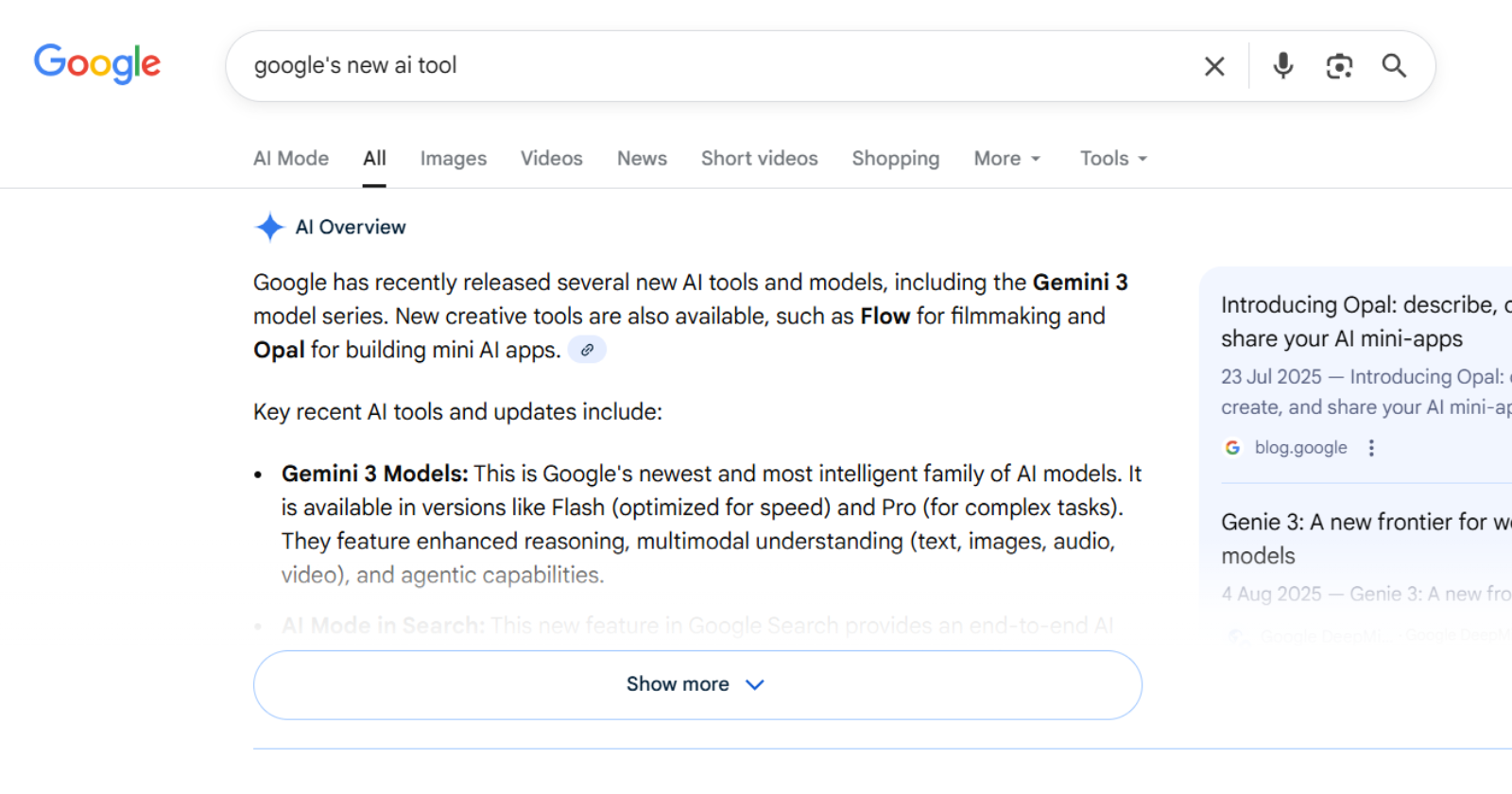
This development correlates directly with the rollout of Google’s AI Overviews. When these AI-generated summaries appear at the top of search results, click-through rates drop by 34.5%. Some publishers are reporting even steeper declines. DMG Media claims drops of up to 89% when AI Overviews trigger for their content.
The small publisher stories paint a starker picture. Charleston Crafted lost 70% of its traffic between March and May 2024. Music blog Stereogum saw 70% of its ad revenue disappear this year. Business Insider experienced a 55% drop in organic search traffic between April 2022 and April 2025, leading to 21% staff cuts.
The structural shift nobody wants to acknowledge
We’re witnessing the collapse of the click-based economy that has sustained digital publishing since the early 2000s. Traffic losses of 20%, 30%, and in some documented cases 90% represent something beyond optimization problems or algorithm adjustments. This is existential territory.
Semrush data shows AI Overviews now appear in 13.14% of all US desktop queries as of March 2025, more than double the January figure. BrightEdge research confirms that longer, conversational queries trigger these summaries far more frequently. Exactly the kind of searches that used to drive the most valuable traffic to publisher sites.
The educational content sector offers perhaps the clearest example. Learning platform Chegg reported a 49% decline in non-subscriber traffic between January 2024 and January 2025. The timing? It coincided with AI Overviews answering homework and study questions that previously drove traffic to educational sites.
Real estate queries saw a 258% increase in keywords triggering AI Overviews between January and March 2025. Transportation jumped 223%. Restaurants increased 273%. These aren’t marginal shifts. They’re wholesale transformations of entire content categories.
When survival depends on a monopoly’s goodwill
The legal response has begun, though whether it will matter remains uncertain. Penske Media Corporation, parent company of Rolling Stone, Billboard, and Variety, filed suit against Google in September 2025. The lawsuit claims that 20% of searches linking to Penske sites now include AI Overviews, correlating with a more than 30% drop in affiliate revenue.
Chegg followed with its own antitrust complaint. The Independent Publishers Alliance filed with the European Commission. Multiple publishers are exploring regulatory channels in the UK as well.
The core legal argument centers on a fundamental asymmetry: Google’s near-90% search market share means publishers cannot opt out of AI Overviews without disappearing from search entirely. The traditional “indexing for traffic” exchange has been replaced by a forced extraction model. Publishers supply content for AI summaries that can entirely replace the need for visits.
Google’s response remains consistent across all legal challenges. The company claims AI Overviews send traffic to “a greater diversity of sites” and that these features enhance the search experience. Yet the actual data from publishers tells a different story. When Pew Research Center studied user behavior, they found that only 8% of users who encountered an AI summary clicked on a traditional search result link. Users who did not encounter an AI summary clicked nearly twice as often.
The subscription pivot and the partnership gamble
Some publishers are shifting to reader-supported models rather than fighting the traffic decline. Stereogum announced paid subscription tiers, members-only playlists, and an on-site tip jar. The logic makes sense when 70% of your ad revenue has vanished. You turn to the audience that remains and ask them to pay directly.
Others are pursuing content licensing deals with AI companies. Google signed its first AI content licensing agreement with The Associated Press in January. Meta, Microsoft, and Amazon have entered the market as well. The Really Simple Licensing Collective launched in September with over 50 publishers, including People Inc., Ziff Davis, Yahoo, BuzzFeed, USA Today Co., and Vox Media.
These deals provide some immediate revenue. But as Condé Nast CEO Roger Lynch noted, if courts determine that AI companies’ actions constitute “fair use,” licensing agreements may not get renewed. Publishers could receive temporary payments before being “left out to dry.”
The optimization trap that won’t save anyone
The SEO industry has responded with what it calls Generative Engine Optimization. The theory is that publishers should optimize specifically for AI citations. Get mentioned in the AI Overview and you capture what traffic remains.
The data shows some validity here. Brands cited in AI Overviews see their organic click-through rates increase by 35% and paid click-through rates jump 91% compared to non-cited competitors. In a zero-click world, being the one source AI chooses to reference makes a material difference.
But this strategy has significant limitations.
First, it requires publishers to accept the premise that AI summaries are permanent fixtures and that their role is to compete for scraps within that system.
Second, AI citations prove volatile. Content referenced one month can be replaced the next without explanation.
Third, the strategy only addresses informational queries where citations matter. For most content types, users simply consume the AI-generated answer and leave.
The industry advice about writing “for humans in a way that AI systems can easily parse” represents a fundamental confusion about what’s actually happening. Publishers are being asked to optimize for systems that extract value from their work while providing diminishing returns.
What the diversification playbook actually requires
UK publisher Future plc, whose portfolio includes TechRadar, Marie Claire, and Go.Compare, reports that only 27% of its sessions now originate from Google search. The company developed what it calls a “Google Zero” strategy, building audience relationships through other channels.
This approach makes sense in theory. Social platforms, email newsletters, direct traffic, and community-building offer some independence from search algorithms. But the execution reveals new problems. Social platforms algorithmically demote posts with outbound links. They reward native content that keeps users in-app, creating their own version of the zero-click problem.
The real diversification challenge requires publishers to build businesses where traffic becomes less central to the revenue model. That might mean events, consulting services, courses, membership communities, or other structures where the value exchange happens directly between publisher and audience.

The uncomfortable question underneath everything
Search volume continues to grow. Google processes an estimated 9.1 to 13.6 billion searches per day in 2025, up from 8.5 billion in 2024. People are searching more than ever. They’re clicking less.
This creates what analysts call the “organic traffic paradox.” Even though the percentage of searches ending in zero clicks has increased, the absolute number of searches has grown faster. Theoretically, this means more total clicks are available than in previous years.
Yet the majority of publishers are experiencing substantial traffic declines. The implication is that traffic is consolidating. Fewer sites are capturing more of the available clicks. The long tail of mid-sized and smaller publishers is being systematically starved of the search traffic that once sustained them.
We’re moving toward a search ecosystem where a handful of publishers maintain visibility while the rest fade into irrelevance. The question is whether independent digital publishing can survive in that environment.
Where this actually leaves bloggers
For individual bloggers and small publishers, the mathematics are particularly brutal. You cannot negotiate licensing deals with Google. You cannot afford to diversify into events or build subscription infrastructure at small scale. You cannot outcompete major brands for the limited AI citations available.
The advice to “focus on experience-based stories, interviews, and opinion pieces” recognizes that these content types trigger AI Overviews less frequently. But this also means abandoning informational content, how-to guides, and definitional pieces. Exactly the content that has historically performed best for building audiences.
Some content will always require clicks. Transactional searches where users intend to purchase. Local searches needing current information. Research queries requiring multiple sources. The question is whether capturing 30-40% of searches rather than the 50-60% accessible in previous years leaves enough economic opportunity for most publishers.
The honest answer? For many, probably not. We’re likely to see continued consolidation, with smaller independent sites either closing or selling to larger entities that can operate at scale.
The clarity that pretending doesn’t provide
The era of managed decline is over. Publishers are no longer guessing what the post-platform world looks like. We’re living in it now. The zero-click era arrived while most of the industry was still optimizing for a search paradigm that no longer exists.
What happens next depends on whether publishers accept the reality of their situation or continue optimizing for a traffic model that’s being systematically dismantled. The legal challenges may produce some constraints on how AI companies use content. Licensing deals may provide some revenue. Citation optimization may capture some residual traffic.
But none of these strategies address the fundamental problem: the economic model that sustained independent publishing is being replaced by one where platforms extract value from content without adequately compensating creators. That’s not a temporary adjustment or an algorithm update. That’s a structural transformation.
The publishers who survive will be those who build businesses that can function in a world where search traffic continues to decline year after year. Not because they want to, but because that’s the reality they’re operating in whether they acknowledge it or not.