This post was significantly updated in 2026 to reflect new information. An archived version from 2010 is available for reference here.
In 1993, when MPEG-1 became the first video compression standard, online video meant heavily pixelated 240p clips that tested patience more than entertained.
RealPlayer launched in 1995, followed by Windows Media Player in 1997, each requiring specific codecs and separate downloads.
The shift from that dial-up era to the $159.98 billion streaming industry we navigate daily happened faster than most realize. What changed between those stuttering clips and today’s seamless 8K streams reveals patterns about platform dependence, creator economics, and how quickly revolutionary technologies become invisible infrastructure.
Through the early 2000s, as broadband adoption accelerated, Flash video became the dominant format. Vimeo launched in 2004, making video sharing possible, but technical barriers remained high. Services charged users to upload and host clips, creating economic friction at every step. The complexity kept video creation confined to those with resources and expertise.
YouTube’s founders recognized that difficulty as an opportunity. When they registered the domain on February 14, 2005, they built something deceptively simple: a Flash-based player that worked in browsers without additional software.
The first video, “Me at the zoo,” went live on April 23, 2005. After opening on a limited beta basis in May 2005, the site attracted 30,000 visitors daily. By December 15, 2005, when YouTube officially launched, it served more than two million video views each day.
That number jumped to 25 million views by January 2006. The site surpassed 25 million videos by March 2006, with over 20,000 new videos uploaded daily. By summer 2006, YouTube delivered more than 100 million video views per day.
The growth wasn’t linear. It was exponential, driven by viral clips that needed no marketing budget. Google’s $1.65 billion acquisition in November 2006 solved the infrastructure problem but created new questions about centralization and control.
The original observation that 69% of internet users watched streaming or downloaded videos now seems quaint. As of 2025, approximately 3.88 billion people use over-the-top video platforms worldwide. Video now accounts for 82% of all internet traffic.
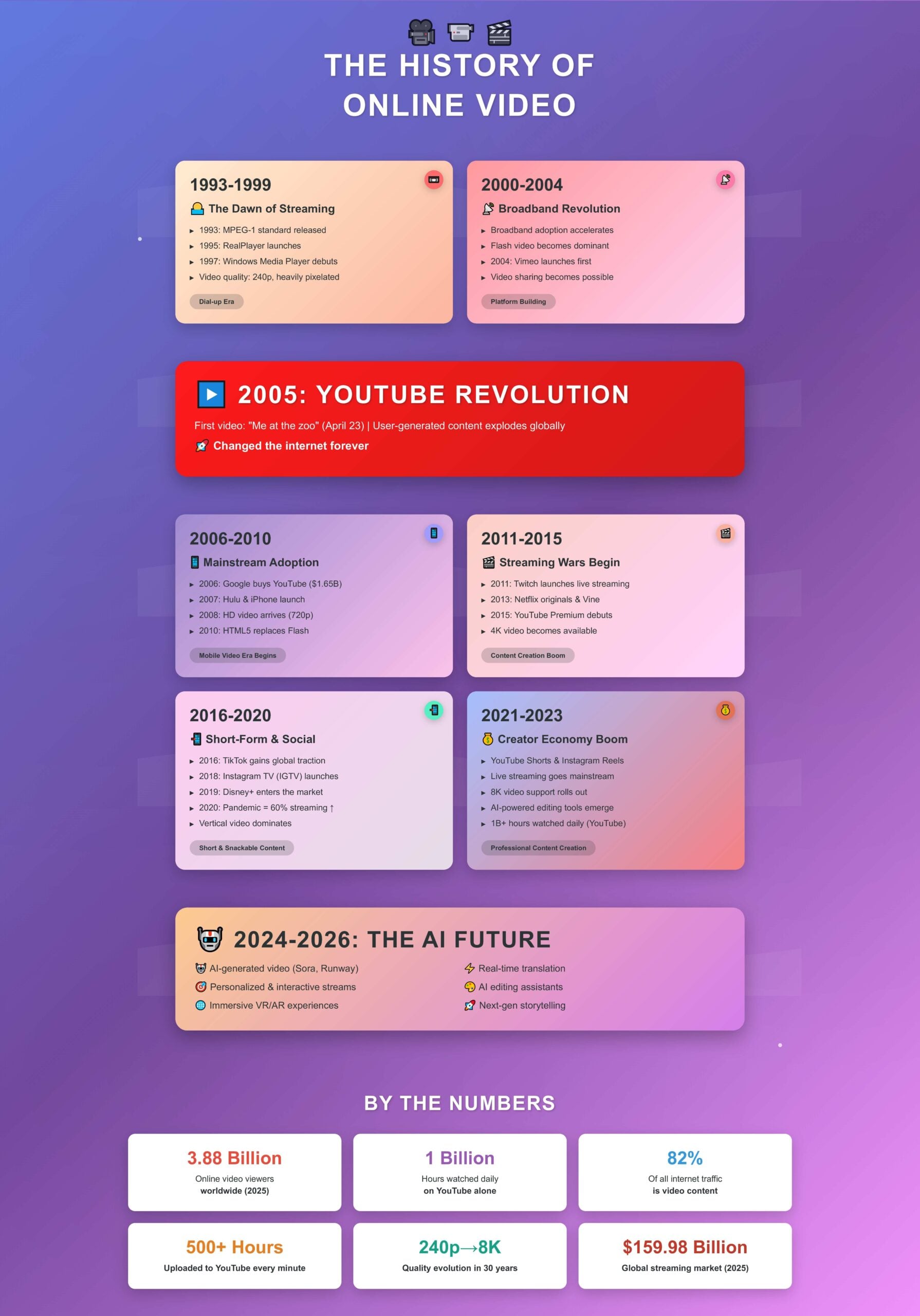
The evolution from niche hobby to cultural infrastructure happened through incremental shifts that compounded into transformation. The infographic below maps those key moments in detail.
What the pattern reveals
Looking back at the timeline from MPEG-1’s 1993 release through today’s AI-generated video tools, the numbers tell a story of inevitable progress.
From 240p pixelated clips to 8K resolution. From RealPlayer downloads to 500 hours of content uploaded to YouTube every minute. From dial-up frustration to 1.2 billion hours watched daily across all platforms.
But the architecture reveals different truths about power and control. YouTube’s transformation from open platform to algorithmic curator shows how quickly democratic tools become centralized systems. The same pattern repeated across streaming services, social media, and digital publishing platforms.
The original excitement about video streaming centered on distribution freedom. Anyone could upload. Everyone could watch. Geography and gatekeepers seemed obsolete. Those promises delivered partially. Distribution opened up. Global audiences became accessible. Niche content found communities.
Yet new gatekeepers emerged. The progression from Flash video dominance in the early 2000s through HTML5’s 2010 takeover, then the streaming wars that began with Netflix originals in 2013, followed by Disney+ entering in 2019, shows consolidation patterns.
Platform policies, algorithm changes, and monetization requirements create invisible barriers that function like traditional media filters.

The difference is opacity. Old gatekeepers announced their decisions. New ones operate through black-box systems that optimize for metrics creators never see.
The timeline shows technological milestones: broadband adoption enabling Flash video in 2000-2004, the iPhone launching mobile video in 2007, HD arriving in 2008, 4K becoming available in 2015, and 8K support rolling out by 2023. Each advancement promised greater access. Each also deepened platform dependency.
Live streaming’s emergence through Twitch in 2011 created new possibilities. TikTok’s 2016 global traction established vertical video and short-form content as dominant formats. YouTube Shorts and Instagram Reels followed in 2021-2023, showing how platforms absorb successful innovations rather than compete against them.
The creator economy boom of the early 2020s produced professional content creation as viable career path, but success increasingly depends on understanding algorithmic preferences rather than authentic expression.
For bloggers and content creators, the lesson extends beyond video. Every platform that promises democratization eventually centralizes control.
The question isn’t whether consolidation happens but how quickly and what leverage creators retain. Understanding that pattern means building strategies around platform independence rather than optimizing for any single distribution channel.
The transformation from QuickTime to YouTube dominance took five years. Similar shifts continue accelerating. The next platform evolution might take five months rather than five years.
AI-powered editing tools, real-time translation, and personalized interactive streams represent the current frontier. They promise convenience and capability. They also introduce new dependencies on systems creators cannot see or control.
Creators who recognize the pattern adapt before the consolidation completes, maintaining flexibility as architectures change beneath them.