


You’ve probably met someone like this. They tell you their age and you genuinely don’t believe them. Not because they’ve had work done or found some miracle supplement — but because something about the way they carry themselves, the clarity in their eyes, the way their skin still has life in it, just doesn’t match the number.
As a psychology writer, I’ve spent years reading the research on aging, longevity, and the psychology of wellbeing. And what strikes me every time is how little of this comes down to genetics. The Danish Twin Study, one of the most cited pieces of longevity research, found that only about 20% of how long the average person lives is determined by their genes. The remaining 80% comes down to lifestyle and environment. Research suggests the same logic applies to how people age visibly.
People who look significantly younger than their chronological age aren’t doing anything exotic. They’ve simply adopted a handful of daily habits — consistently, and for a long time. Here are the ones that show up most often in the research.
They move their bodies without making it a production
The longest-lived populations on Earth — the communities Dan Buettner identified as Blue Zones in Sardinia, Okinawa, Nicoya, Ikaria, and Loma Linda — don’t go to gyms. They walk to the shops. They garden. They knead bread. They take stairs because that’s what’s there. Movement is woven into the fabric of their day, not bolted onto it as a separate obligation.
The science behind this and youthful appearance is more concrete than you might expect. A 2023 study published in Scientific Reports found that both aerobic and resistance training significantly improved skin elasticity and the structure of the upper dermis in middle-aged women over just 16 weeks. Resistance training also increased dermal thickness — a marker that typically declines with age and contributes to the thin, fragile appearance of older skin.
A 2024 narrative review in JMIR Dermatology confirmed that regular exercise can counteract age-related skin changes by promoting mitochondrial renewal and increasing blood flow to the skin by roughly eight times during activity. That’s not a marginal effect. That’s a measurable physiological shift that, over decades, changes how skin ages.
The people who look younger aren’t running marathons. They’re just moving — every day, without drama.
They eat mostly plants, and they don’t eat too much
Across all five Blue Zones, the dietary pattern is remarkably consistent: heavy on vegetables, beans, whole grains, and nuts. Light on processed food and meat. Moderate in total volume.
In Okinawa, there’s a practice called hara hachi bu — a Confucian-origin phrase that reminds people to stop eating when they’re about 80% full. It’s not calorie counting. It’s a cultural cue that prevents overeating before the brain has time to register satiety.
The connection between diet and visible aging is well-established. Diets high in sugar and processed food accelerate the formation of advanced glycation end-products (AGEs), which damage collagen and elastin — the proteins responsible for skin’s firmness and bounce. On the other side, diets rich in antioxidants, healthy fats, and fiber help protect against oxidative stress, one of the primary drivers of both internal aging and the external signs we associate with looking old.
Research suggests that people who maintain a youthful appearance as they age didn’t get there by accident. They got there by eating well most of the time, for most of their life.
They sleep like it matters
This is one of the least glamorous habits on the list, and probably the most consequential. Sleep is when the body repairs damaged cells, produces growth hormone, and regulates the cortisol levels that, when chronically elevated, break down collagen and accelerate aging.
People who age well tend to treat sleep as non-negotiable. They go to bed at roughly the same time. They limit screens before sleep. They don’t wear poor rest as a badge of productivity.
Research consistently shows that chronic sleep deprivation is associated with increased signs of skin aging — more fine lines, uneven pigmentation, and reduced elasticity. A frequently cited study from University Hospitals Case Medical Center found that poor sleepers showed significantly more signs of skin aging and recovered more slowly from environmental stressors like UV exposure.
There’s nothing revolutionary about getting seven to eight hours of sleep. But doing it consistently over decades is what separates people who look their age from the ones who don’t.
They manage stress instead of accumulating it
Chronic stress ages people visibly. It shortens telomeres — the protective caps on chromosomes that serve as biological markers of aging. It elevates cortisol, which thins skin, weakens the immune system, and promotes inflammation. It disrupts sleep, which cascades into everything else.
The Blue Zone populations all have built-in stress-relief mechanisms. Sardinians have an afternoon aperitivo. Adventists observe Sabbath. Ikarians nap. Okinawans spend time in their moai — small social groups that meet regularly.
People who age gracefully aren’t stress-free. They’ve just found reliable ways to discharge it, rather than letting it build up and express itself through their bodies over time.
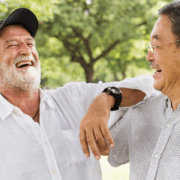
They stay socially connected
Loneliness accelerates aging. This isn’t a metaphor — it’s a measurable physiological effect. Social isolation is associated with higher levels of inflammation, elevated cortisol, weakened immune function, and faster cognitive decline. All of these contribute to how quickly someone ages, both inside and out.
In every Blue Zone, strong social ties are a defining feature. In Okinawa, children are placed into committed social groups called moai at age five. One such group that researchers documented had been meeting for 97 years, with members averaging 102 years old.
People who maintain a youthful appearance as they age almost always have close relationships — not hundreds of acquaintances, but a handful of people they see regularly, talk to honestly, and depend on. Connection isn’t a luxury. It’s infrastructure.
They protect their skin from the sun
This is the most straightforward item on the list, and probably the one most people underestimate. Ultraviolet radiation is the single largest external contributor to visible skin aging — more than diet, more than sleep, more than any cream or serum. Dermatologists call it photoaging, and it accounts for up to 80% of the visible changes we associate with aging skin: wrinkles, sagging, dark spots, loss of elasticity.
People who look remarkably young for their age tend to have a long history of sun protection — whether by wearing hats, seeking shade, or using sunscreen consistently. It’s not about avoiding the outdoors. It’s about not treating your face like a solar panel every afternoon for decades.
They keep learning
Mental stimulation doesn’t just keep the brain sharp — it seems to keep people looking and feeling younger, too. The mechanism is partly indirect: people who stay intellectually curious tend to be more engaged with life, more socially active, more purposeful. All of those things correlate with slower aging.
But there’s a direct component as well. Cognitive engagement helps maintain neuroplasticity, which supports everything from emotional regulation to sleep quality to physical coordination. When the brain stays active, the downstream effects touch every system in the body.
The research paints a consistent picture: people who age well aren’t following some secret protocol. They’re doing simple things — moving, eating well, sleeping, connecting, protecting their skin, staying curious — and they’re doing them consistently over the long haul. The habits themselves aren’t remarkable. The consistency is.