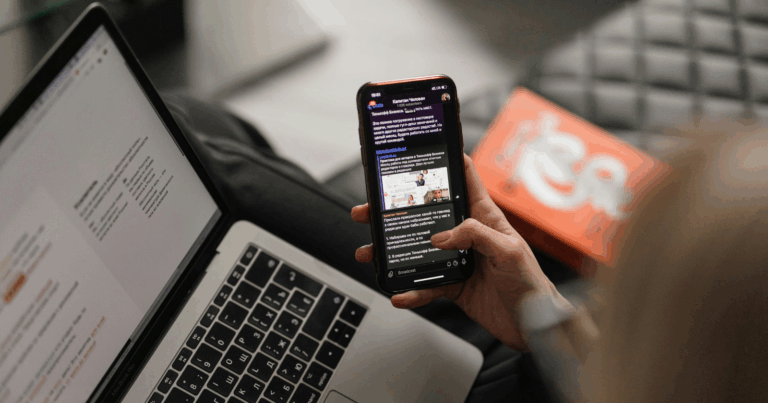
Researchers at Aalto University who tracked how people actually used their phones, rather than how they described using them, found a specific behavioral signature: brief checks, typically under 30 seconds, aimed at a single app, repeated throughout the day whether or not anything new had actually arrived. Antti Oulasvirta and his colleagues called this a checking habit, and when they asked the people doing it how they felt about their own behavior, almost none of them described anything close to addiction. They called it overuse, or an annoyance. From the outside it looked compulsive. From the inside it felt more like an itch nobody could quite locate the source of.
What actually changes during a stressful week
Checking frequency is not stable from week to week. It rises and falls with how someone is doing, and the rise tracks less with how hooked a person already is on their phone and more with how well they can manage a difficult feeling by other means. A 2022 systematic review and meta-analysis in the International Journal of Environmental Research and Public Health pooled the available studies on emotion regulation and problematic phone use and found a moderate, consistent correlation between the two, with a pooled coefficient of roughly 0.42, stronger in younger adults than older ones. The relationship held across dozens of studies using different measures and different populations, which is the kind of consistency that rules out a fluke in any single sample.
Jon Elhai and colleagues went further and proposed a mechanism for that correlation. Their 2016 study in Computers in Human Behavior found that emotional suppression, rather than simple usage volume, mediated the link between problematic phone use and depression, describing the behavior in question as a technique, albeit an ineffective one, for dealing with or regulating negative emotion. In that account, the phone works as the nearest tool for managing distress that is already there, reached for because it is within arm’s reach and delivers relief immediately, even when that relief does not last.
Why addiction measures the wrong thing
Addiction, as a frame, implies escalating tolerance and a substance or behavior a person is chasing for its own sake. The checking-habit research does not describe that. It describes something closer to automaticity: a behavior triggered by proximity and instant feedback rather than by craving. That distinction matters for anyone trying to explain why the same person checks their phone constantly during a bad week and barely touches it during a calm one. If checking were a stable addiction, the frequency would not swing that hard based on external circumstances. If it is standing in for a missing regulation skill, the swing is exactly what should be expected: the tool gets used more when the demand for emotional management rises and no other tool is on hand.
This reframes who the heaviest checkers during a stressful week actually are. They are not necessarily the people with the deepest dependency on their phones. They are often the people who never built a second option, whose repertoire for managing a spike in anxiety or dread has exactly one entry in it, and that entry happens to fit in a pocket.
It also explains why the standard fixes marketed against phone overuse, app blockers, grayscale screens, notification bans, tend to fail during exactly the weeks a person needs them most. Those tools remove the fast option without installing a replacement. For someone with an alternative already in place, that subtraction is enough. For someone without one, it just removes the only regulation tool they had, at the worst possible time to be without it.

What this means for anyone trying to write through a hard stretch
Writers and bloggers run into this pattern in a specific, recognizable form: the reflexive check between finishing a paragraph and starting the next one, or between sending a pitch and hearing back. Under ordinary conditions that is a minor tic. During a stressful week, a missed deadline, a client dispute, a launch that is not going the way it was supposed to, the checks compress. They get more frequent and shorter, and they start showing up mid-sentence instead of between sessions. That pattern is easy to read as a discipline problem, a failure of will against a phone engineered to be hard to put down. The regulation research points to something more specific and more fixable: the check is filling a short gap that a person has not yet built another way to fill.
What fills that gap for one person will not fill it for another. What the research does support is that the fix is not simply checking the phone less, which treats the symptom. It is building a second, equally immediate option for the moment a hard feeling shows up in the middle of a draft. Without that second option, the phone keeps winning by default, not because anyone is addicted to it, but because it is the only tool within reach.