Most of my news reaches me by accident. It’s on X, in science discussions, or in a viral headline that pops up while I’m scrolling. I’ve put real effort into filtering out the trash and spam pages, so I like to think my feed is fairly well behaved by now.
News from home is another story. I’m from Georgia, the country, not the US state, and there people tend to be either for the government or against it, with almost nothing in between. You can see it clearly in the media. Two outlets can cover exactly the same story in completely different ways. It annoys me every single time. From what I read, the US isn’t so different.
Ask the internet why outlets do this, and the answer is simple: anger sells. Oxford University Press even made “rage bait” its word of the year for 2025, after the term’s use tripled in twelve months.
So when I came across a study of 22,743 headline experiments, I thought I knew how it would end. Anger is a drive. It’s energy, it makes people feel something, and nobody really expects to feel happy or satisfied reading the news. I’d have bet on the angry headlines.
I’d have lost.
Between January 2013 and April 2015, the website Upworthy tested different headlines for the same story on different readers, chosen at random, and counted the clicks. In a 2023 study in Nature Human Behaviour, Claire Robertson, Jay Van Bavel and colleagues went through those tests. Negative words did win clicks: in an average 15-word headline, each negative word raised the click rate by about 2.3%. But when they split negativity into emotions, sadness words raised clicks, fear and joy words lowered them, and anger words made no measurable difference.
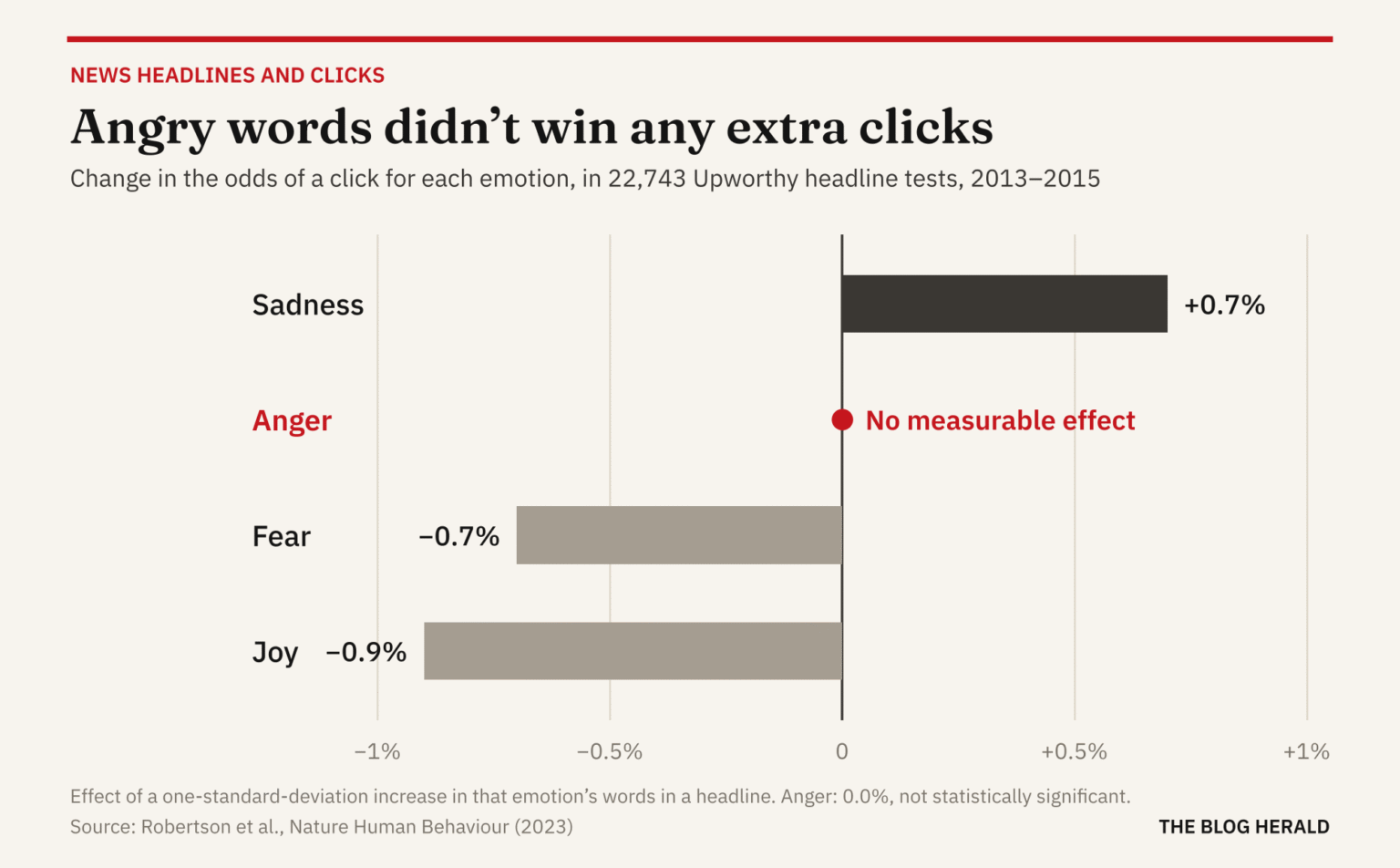
This was Upworthy, which the authors call “one of the most successful pioneers of click-bait in the history of the Internet.” Each result is about a headline, not a person, and a click isn’t a share. The authors also say their test couldn’t prove anger has no effect at all, only that they couldn’t find one.
So if anger doesn’t get the click, what keeps people coming back to outlets that make them angry? I asked the researchers who study it.
Anger clearly pays someone. But who’s buying?

Gregory Martin is an associate professor of political economy at Stanford Graduate School of Business. With Ali Yurukoglu, he wrote a 2017 study of bias in cable news. He told me straight away that he isn’t a psychologist. He can think of people he knows who “seem, by revealed preference, to enjoy getting angry at a television,” he said, “but I don’t have a great insight into why that is.”
“Anger is a politically useful emotion, and it’s clear enough why political elites would want to stimulate anger among their base of support, but less clear why the base would want to tune in for that.” — Gregory Martin, Stanford Graduate School of Business
This is the part I keep coming back to. Anger clearly works for the people selling it. For the rest of us, it means choosing, again and again, to feel worse. So either anger gives us something we want, like that jolt of energy I mentioned, or it isn’t really the anger we come back for.
Angry headlines doubled in 20 years. Why?
Outlets certainly sell more of it. David Rozado and colleagues had language models label 23 million headlines from 47 popular US outlets, from 2000 to 2019. The share of headlines labelled angry rose by 104%. Fear rose by 150% and sadness by 54%, while neutral headlines fell by 30%.
Diego García, a finance professor at the University of Colorado Boulder, has seen a similar shift on TV. In “Selling anger”, a working paper with Ryan Lewis and Maximilian Rohrer, he went through closed captions from six cable networks between 2012 and 2024. The networks increasingly talked about the opposing party. In 2024, Fox covered Democrats 60% of the time, and MSNBC did the reverse.
I asked him why. “I can only speculate here, as our paper is purely observational,” he said. Social media took off at the start of their data, and “what this allowed media companies to do was to run A-B tests to see what type of stories would increase engagement (hours in the app). They must have figured out talking trash about the opposition works best!?” He was careful about it: “No scientific basis for the above claim, but it resonates. It was impossible (or very hard) to do A-B testing in 2005. By 2015 it was close to trivial.”
Which made me smile a little, because Upworthy’s archive is exactly that kind of A-B test. And in those tests, anger on its own didn’t win. Something else did.
Maybe it’s not the anger, but who it’s aimed at
In a 2021 study in PNAS, Steve Rathje, Jay Van Bavel and Sander van der Linden looked at 2.7 million Facebook and Twitter posts from US news outlets and members of Congress. For the news outlets’ accounts, each word about the opposing political side raised shares by 35 to 57%. On those outlets’ Facebook pages, “angry” was the most common reaction, for liberal and conservative outlets alike. Across all the accounts, words about the other side predicted shares about 4.8 times as strongly as negative words did.
The paper lists some of the most-shared posts, and they read like what I scroll past every day. One of them, from a conservative outlet: “Every American needs to see Joe Biden’s latest brain freeze.” One from a liberal outlet: “Vice President Mike Pence blatantly lied to reporters about the trajectory of COVID-19 cases in Oklahoma […]”
When I asked Jay Van Bavel, a psychologist at New York University, whether a shared opponent is what keeps an audience coming back, he answered: “Yes, negativity and outgroup animosity both drive engagement.”
Daniel Mochon, a marketing professor at Tulane who studies why people engage with posts they disagree with, had a similar feeling. “I am not sure I know the answer,” he said. “However, my intuition is that audiences return to outlets that make them angry because it feels good to confront and stand up to people they disagree with. The problem is that it is unclear whether this kind of confrontation benefits anyone.”
This sounded familiar. Back home, when two outlets cover the same story in completely different ways, each one is really telling a story about the other side. It might also explain why the two studies don’t clash.
A click is something you do alone. A share is something you do in front of everyone.
Why the angry channel can feel like home

Erin Cikanek, a political scientist and Klarman Fellow at Cornell, measures emotion in TV news. In one sample, 27 of 30 Fox News prime-time segments on 4 and 5 January 2021 were angry in tone. I asked whether viewers come back for the shared feeling or for the information.
“People will rely on their social identities – partisanship – to make choices about media,” she said. She couldn’t point to work that separates the two, but she guessed “it is some combination of the two: information that does not challenge prior beliefs and emotions that allow them to do the same and rely on political habits in line with their partisan identities.”
Kevin Arceneaux, a political scientist at Sciences Po who co-wrote the book Changing Minds or Changing Channels?, said there isn’t a simple answer. “For some it becomes a habit; for some, it is something they truly enjoy; for others, they do it to prepare for what they fear will be the worst.”
Back in 2014, Jeffrey Berry and Sarah Sobieraj had interviewed fans of outrage shows for their book The Outrage Industry. Those shows, they wrote, “function as safe havens for audience members increasingly uncomfortable” with real-world political conversations.
A safe haven that makes you angry sounds strange at first. But if everyone around you is angry at the same people, at least you know where you stand.
We keep watching. That doesn’t mean we like it
In a 2025 review in Trends in Cognitive Sciences, which Van Bavel sent me, he and Rathje point to a survey of 511 Americans. People knew divisive content goes viral, and most of them didn’t want it to. The authors call this the paradox of virality: “widely shared content is not necessarily widely liked.” Some of us may dwell on a post, they write, much as people feel they “cannot look away from a car crash on the side of the road.”
Arceneaux added a flip side: “many people choose to avoid the news because it makes them upset.”
I’m probably closer to that second group. I don’t really hate-read. I try to keep my nervous system sane.
Still, keep in mind that nobody here followed the same people’s loyalty to one outlet over months. Upworthy counted clicks, the PNAS study counted shares, and several of the answers above are the researchers’ own guesses, which they said themselves.
I started out sure that anger was the hook. Now I suspect it’s more like the packaging. What’s inside is the other side, the people who agree with us, and the habit of checking in. The next time a Georgian headline annoys me, I think I’ll ask not what it says, but who it wants me to stand next to.
Sources:
- Robertson et al., Negativity drives online news consumption, Nature Human Behaviour, 2023.
- Rathje et al., Out-group animosity drives engagement on social media, PNAS, 2021.
- Rozado et al., Longitudinal analysis of sentiment and emotion in news media headlines using automated labelling with Transformer language models, PLOS ONE, 2022.
- Rathje and Van Bavel, The psychology of virality, Trends in Cognitive Sciences, 2025.
- García et al., Selling anger, SSRN working paper, 2025.