Every now and then someone tells me psychology isn’t a real science. I’m doing a PhD in it, so I take it more personally than I should. The complaint usually comes with a picture of what real science looks like, and that picture usually involves a brain scanner. As if you had to run an fMRI to study people properly.
So I’ve stopped arguing and started asking: what do you mean by science?
Then I give them mine. Science is asking a question in a way that lets the answer prove you wrong: you measure carefully, you show how you did it, and someone else can check. And yes, in those moments I defend psychology harder than I’d like to admit.
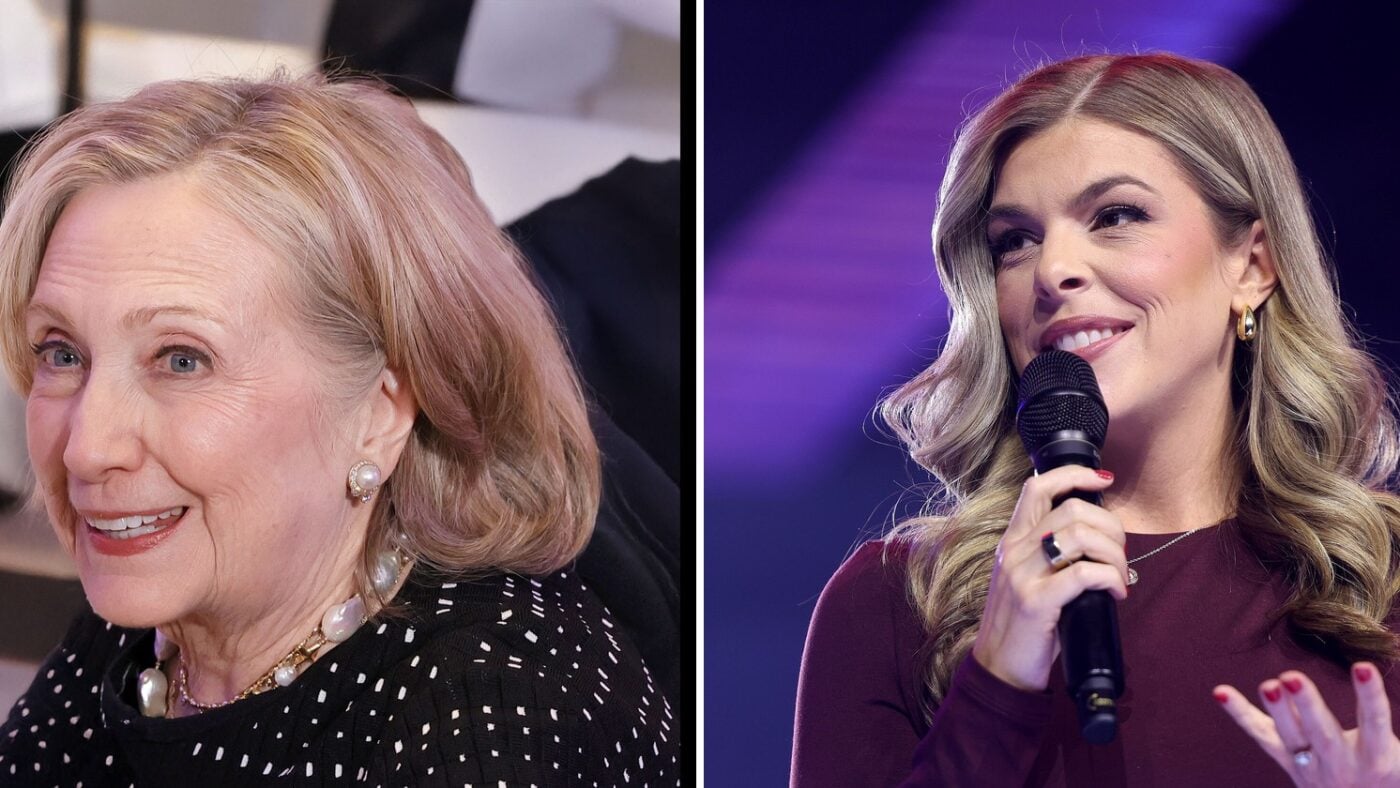
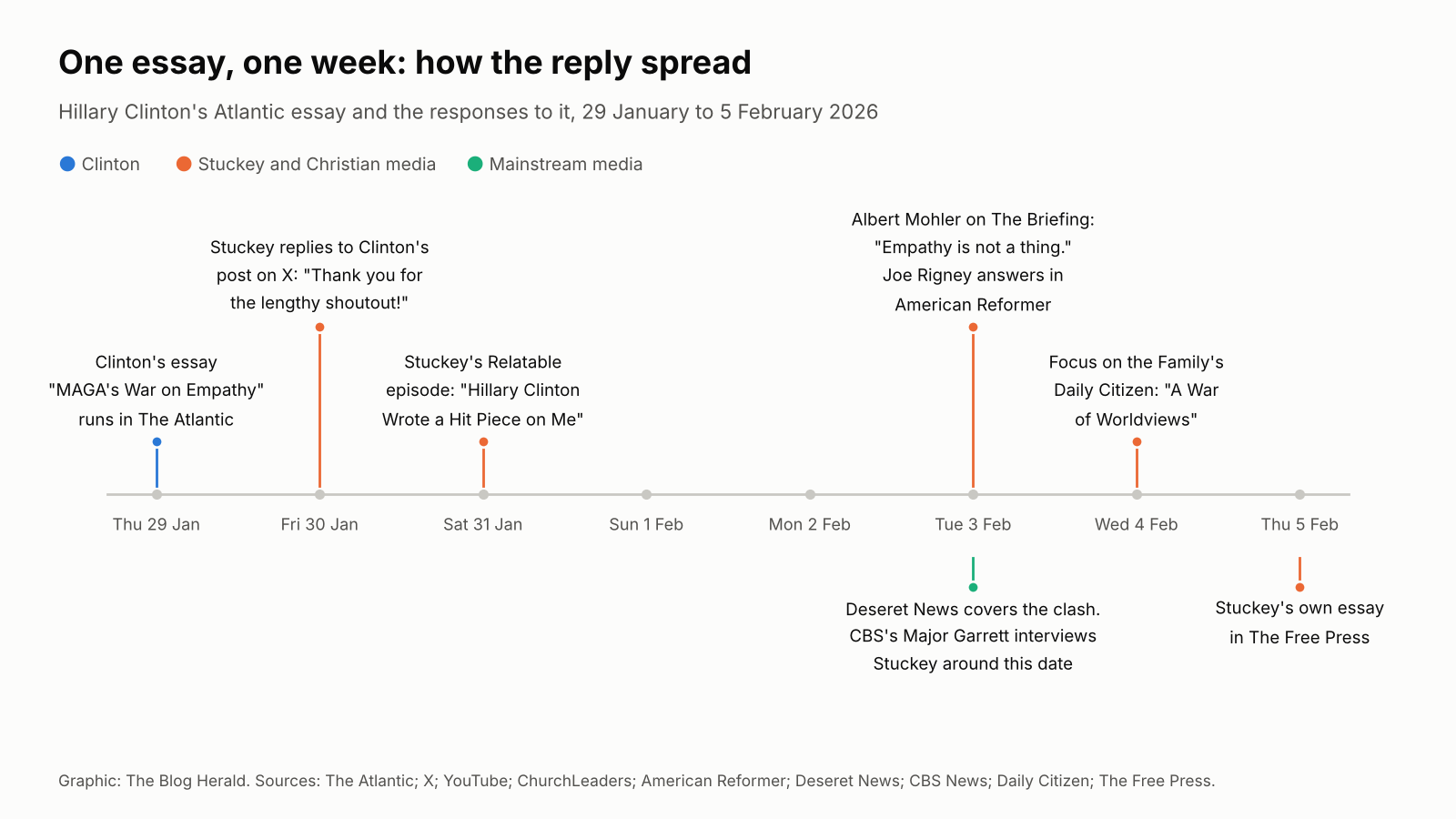
When Hillary Clinton went after the Christian podcaster Allie Beth Stuckey in The Atlantic on 29 January 2026, I had a fair idea of what would come next. The next day Stuckey replied on X: “Thank you for the lengthy shoutout! I’ve got a response headed your way.”
The title says this was exactly what her audience needed. That’s my argument. Nobody has surveyed her listeners. But Stuckey’s own words, what the people around her did next and a few public numbers make the case better than I could.
Three paragraphs and a “commissar”
Clinton’s essay, “MAGA’s War on Empathy”, is long, and most of it is about Donald Trump and his movement. Stuckey is one of several people she names. But she gets more than a passing mention.
Clinton calls her “the right-wing Christian podcaster Allie Beth Stuckey” and quotes her X post calling a sermon by Episcopal Bishop Mariann Edgar Budde “toxic empathy that is in complete opposition to God’s Word and in support of the most satanic, destructive ideas ever conjured up.” Clinton’s answer: “Toxic empathy! What an oxymoron. I don’t know if the phrase reflects moral blindness or moral bankruptcy, but either way it’s appalling.”
A paragraph later she calls Stuckey a “commissar of MAGA morality” who “targets other evangelicals whose empathy, she warns, has left them open to manipulation.” Further down: “Influencers like Stuckey are zealously policing any deviation from the party line.”
Here’s a detail I didn’t see in the coverage. Stuckey’s written reply in The Free Press opens: “She just accused me of thinking empathy is a sin. That’s not my argument.” But the essay’s sentence about sin doesn’t name her. It reads: “We already have Christian influencers saying empathy is a sin.” The book with that idea in its title belongs to the pastor Joe Rigney, whose Leadership and the Sin of Empathy Clinton names separately. Stuckey may well be right that her argument is different. She’s also answering a line that wasn’t about her alone.
And Clinton writes that empathy “does not overwhelm our critical thinking or blind us to moral clarity.” Stuckey’s worry, as she put it on her show, is the moment when “You are so deeply in one person’s feelings that you no longer can think objectively.” On paper, they’re closer than either side made it sound. That didn’t stop anyone.
“It is not actually about me”
On 31 January Stuckey answered on her show, Relatable, in a 29-minute episode called “Hillary Clinton Wrote a Hit Piece on Me. My Response.” BlazeTV, which carries the show, wrote it up with her quotes. The first thing she did was hand the attack to her listeners.
“This article might mention me by name, but it is not actually about me,” she said, “because the truth is, if it weren’t for all of you, Hillary Clinton would not care about me.”
Then came the reading of it: “we are over the target.” And: “They don’t trot out former Secretary of State, former presidential candidate Hillary Clinton, unless they are really worried.” About her own book, Toxic Empathy, she said Clinton had “put more eyes on” it. Honest, at least.
The episode’s description on YouTube does the same work in writing. It promises her answer to “the lies portrayed of her in this article” and asks: “Why is she attacking Allie and others right now? Democrats are trying to sway the Christian vote.” She closed with Luke 6:22: “Blessed are you when people hate you and when they exclude you and when they revile you and spurn your name as evil”.

Allie Beth Stuckey’s reply to Clinton on Relatable, premiered 31 January 2026 by Allie Beth Stuckey and BlazeTV. It had about 272,000 views by mid-October.
Everyone she named seemed pleased
Stuckey wasn’t the only one. According to The Christian Post, Rigney, whom Clinton calls “the extremist pastor Joe Rigney”, urged his publisher “to reprint the cover of Leadership and the Sin of Empathy with [Clinton’s] enthusiastic endorsement.” Douglas Wilson, “the influential Christian nationalist” in Clinton’s words, joked about it too.
The wider Christian media picked it up within days. Albert Mohler told listeners of The Briefing on 3 February that “Empathy is not a thing,” ChurchLeaders reported. Focus on the Family’s Daily Citizen framed it as “A War of Worldviews”. And CBS News’s Major Garrett sat down with Stuckey for an extended interview. That’s a former secretary of state and a national TV network in one week.
I don’t think anybody can buy that kind of promotion.
Why criticism from outside bounces off
In 2004 the social psychologist Matthew Hornsey and his co-author Armin Imani published studies in Personality and Social Psychology Bulletin on what they call the intergroup sensitivity effect. People see the same criticism of their group, made either by a member or by an outsider. In one study, Australians read negative comments about Australians. When an Australian made them, only five percent strongly disagreed. When an English critic made the identical comments, half did, the University of Queensland reported. A foreigner who had lived and worked in Australia for years met just as much defensiveness.
I recognised myself in that study straight away. I criticise Georgia often, to locals and foreigners alike. There’s a lot my country deserves a critique for, objectively. But when someone who doesn’t have the full context does it, it sounds like a personal attack. Even when I know they have a point, it feels wrong, and I can’t do anything about it.
“according to my research we are super-quick to reject criticism from outsiders, even where they have a legitimate basis.” Matthew Hornsey, University of Queensland News, 2004
It holds in politics too. In 2020, Levi Adelman and Maykel Verkuyten ran three experiments with Dutch adults on a heated topic: how the Netherlands receives refugees. In all three, people agreed more with a critic from inside their group than from outside. In the two studies that asked, they also rated the insider as more constructive and more expert.
That’s the part that makes me a little uncomfortable. The effect doesn’t check who is right. Clinton could be entirely right about Stuckey, or entirely wrong, and the research suggests her words would land the same way with Stuckey’s listeners: as an outsider’s, from about as far outside as it gets. It works on Atlantic readers too, when the critic is someone like Stuckey.
Who the enemy has to be
There’s also a longer story about why this works so well with evangelical audiences. In 1998 the sociologist Christian Smith argued, in American Evangelicalism: Embattled and Thriving, that American evangelicalism is strong because it sees itself as embattled. It “thrives on distinction, engagement, conflict, and threat,” as Lauren Winner quoted his argument in her review. His evidence included 130 two-hour interviews and 2,591 phone surveys.
The sense of being under pressure has grown since. In 2009, 42 percent of white evangelicals said evangelical Christians face a lot of discrimination. By 2023 it was 60 percent, according to Daniel Cox at the Survey Center on American Life. Cox doesn’t write it off as a persecution complex. He points to how fast American culture moved on sexuality, and to politicians who amplify the fear.
Put Smith and Cox next to Stuckey’s episode and the business logic is plain. A show like hers needs an outside world that disapproves of its listeners. A former secretary of state calling its host a “commissar” in The Atlantic is that world in its clearest form. Clinton walked straight into the role Stuckey’s audience already expects someone to play.
Did the attack actually help her?
Nobody has surveyed her listeners, but a few public numbers point the same way. On her YouTube channel, the Clinton episode has about 272,000 views. The eight episodes around it, four before and four after, have between 63,000 and 70,000 each. That’s roughly four times her usual audience for one episode.
On X, Clinton’s post sharing the essay had 2.8 million views and 4,800 likes by mid-October. Stuckey’s reply had 322,000 views, about a ninth as many, and 4,500 likes. Almost as many people liked her answer as liked the essay announcement itself.
Google searches tell a quieter story. In the week after the essay, US searches for Stuckey’s name ran about 75 percent above the two weeks before, according to Google Trends. Then they fell back. Her October 2025 debate with 20 progressive Christians on the YouTube channel Jubilee drew about three times as much search interest. So my reading is this: the attack didn’t bring many new people to her. It lit up the ones already there.
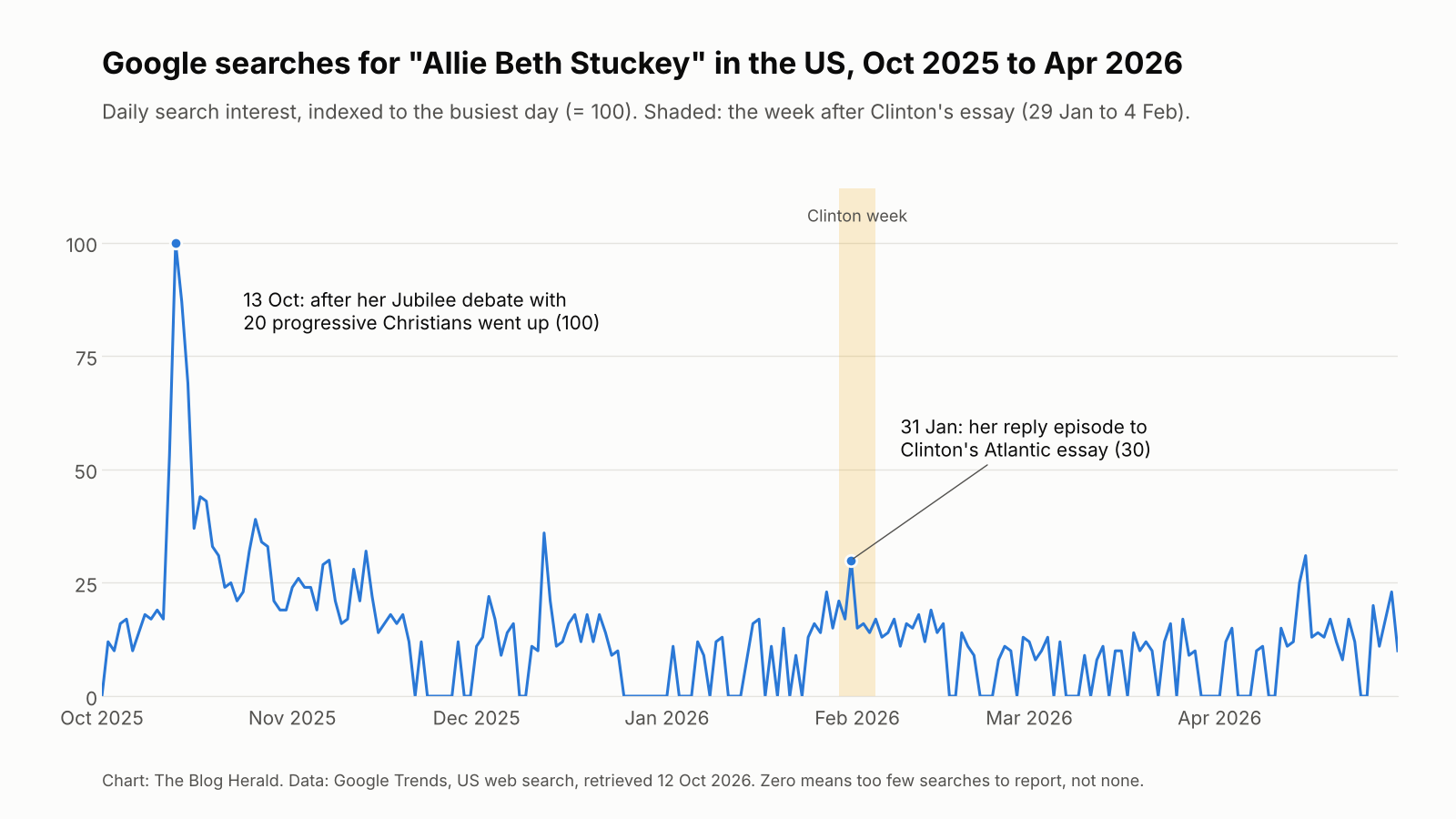
Now the limits, because there are real ones. Views and likes measure attention, and Google Trends gives relative interest from a sample of searches. Neither can tell you what anyone believes. And the one experiment I found on this kind of message gives a mixed answer. In a 2021 study, the independent researcher Luke Herrington had 816 American adults read either an article framing Christians as persecuted or an unrelated one about Mars. Across everyone, their sense that religious liberty was under threat barely moved, and the differences weren’t statistically significant. But conservatives who read the persecution story were especially likely to feel that threat, he reports. It was one online study with paid survey-takers, so I’d hold it loosely. Still, it fits what the numbers above suggest. An attack like Clinton’s may not change anyone’s mind. It may just bind the people already listening a little tighter.
Next time someone tells me psychology isn’t a science, I’ll still ask for their definition. I’ll just keep in mind that, to them, I’m the outsider.