I’ll admit something slightly awkward for someone writing about social media: I’ve never used Bluesky. I didn’t even know a platform like Twitter existed until last year, when someone mentioned it in my research lab in Germany. So I’ve never been in either of these rooms. Maybe that’s why the number that stuck with me isn’t how many users Bluesky lost. It’s how rarely the people on it seem to disagree.
First, though, the number everyone quoted this summer. In August, TechCrunch reported Similarweb data showing that Bluesky’s app averaged about 22.1 million monthly active users at the end of 2024, and 10.7 million in April to June 2026. That’s a drop of around 52%. Half, give or take.
Half of what, exactly?
I always want to know what a number is counting before I believe it. This one counts the mobile app only. In the same report, X and Threads also got website figures. Bluesky didn’t. And Bluesky itself doesn’t publish how many people actually use it. It shows the number of registered accounts, which TechCrunch put at nearly 46 million.
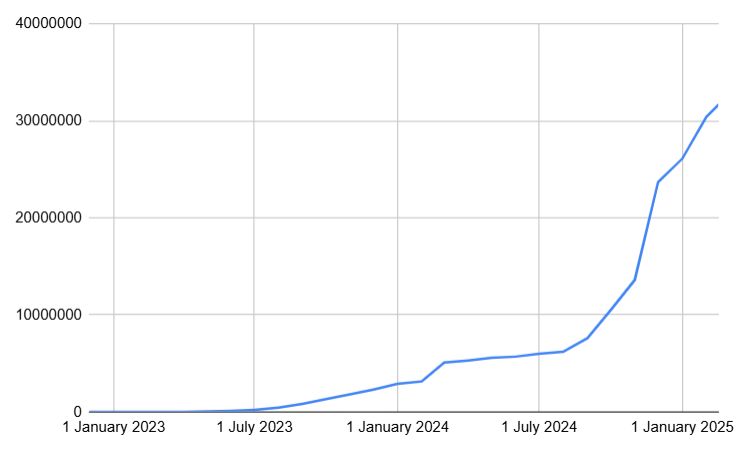
So I’d read “half” as half of the app’s regular users, by one company’s estimate. Still a lot.
There’s one more detail that most headlines skipped. The people who stayed are fairly active. Similarweb puts the share of monthly users who open the app on any given day at about 29%, roughly the same as Threads. So the room is smaller, but people are still in it.
Who moved in after November 2024?
The big wave came after the 2024 US election. Pew Research Center has been tracking 500 news influencers, people with at least 100,000 followers who post about current events. Before Election Day, 21% of them had a Bluesky account. By March 2025, 43% did.
Who they were matters more than how many. Among influencers who leaned left, 69% had joined Bluesky. Among those who leaned right, 15% had.
But most of them didn’t actually leave X. Three-quarters of the left-leaning influencers still had an X account, and 83% of influencers on X posted there four or more days a week. On Bluesky, almost half (48%) didn’t post regularly at all. Many moved in, it seems, but kept the keys to the old flat.
The lean wasn’t new, either. An earlier study by Dorian Quelle and Alexandre Bovet at the University of Zurich, covering about five million users from 2023 to May 2024, found that most shared news came from left-of-centre outlets.
What happens when the other side is 1% of the room?
The study that made me stop and reread was done by researchers at Aalto University and the University of Zurich. They collected all activity on Bluesky from December 2024 to May 2025: 13.5 million new profiles and more than a billion posts. About 13% of posts were about politics.
Then they looked at the most divided topics, the ones where people split into two camps. On those, the smaller camp was “only 1–2% of the users,” in the words of their summary. In the body of the paper it’s “1% or less” in every case. Their conclusion: Bluesky has “a more politically homogeneous user base than was typical prior to the current wave of platform fragmentation.”
In most studies I know, a 1% group would be a footnote. Here it’s the entire opposition. Two caveats, from the authors themselves: an AI model sorted the posts into sides, with only spot checks by people, and they looked at English-language posts. It’s also a preprint, so it hasn’t been through peer review yet.
And when the other side did show up, it didn’t get a debate. In October 2025 the White House joined Bluesky with a sarcastic “What’s up, Bluesky?” video. Within two days it was the second most-blocked account on the platform, behind only Vice President JD Vance, Gizmodo reported, using data from the block tracker Clearsky. People didn’t argue. They blocked.
Do we need someone to argue with?
There’s a good reason to think a fight keeps a feed alive. In a 2021 study in PNAS, Steve Rathje, Jay Van Bavel and Sander van der Linden looked at 2.7 million posts from news outlets and members of the US Congress on Facebook and Twitter. Each word about the other political side raised the odds of a post being shared by 67%. That was about 4.8 times the effect of negative words, and 6.7 times the effect of moral-emotional ones. Posts about the other side also drew more “angry” reactions.
Take the other side away, and you take away a lot of that fuel. Mark Cuban, one of Bluesky’s best-known users, said much the same on the platform in June 2025, sharing a Washington Post opinion piece headlined “Bluesky’s decline stems from never hearing from other side.”
The lack of diversity of thought here is really hurting usage. www.washingtonpost.com/opinions/202… Opinion | Bluesky’s decline stems from never hearing from other side – The Washington Post
Less than an hour later, he added this:
The moderation and block tools on here are so advanced , if you see someone you don’t want to see on here, just block them. Don’t attack them. There used to be great give and take discussions on politics and news. Not so much any more. Doesn’t have to be this way
Not everyone thinks that’s a problem. Mike Masnick, who founded Techdirt and sits on Bluesky’s board (he says so at the top of his piece), answered the critics with a knitting circle: you don’t join one and complain that everyone wants to talk about knitting. “Most people aren’t looking for a debating arena,” he wrote. The political scientist Daniel Drezner had made a similar point before the big wave, admitting in a 2024 post that Bluesky was “definitely more homogenous than, say, the Twitter of a decade ago.” He stayed anyway, because his “utility from Bluesky comes from who else is there.”
“As a result, the clash of conflicting views is diminishing, not because the surrounding polarization has decreased, but because individuals with differing political attitudes are increasingly segregated into separate, self-reinforcing digital environments.” — Salloum et al., “Politics and polarization on Bluesky” (2025)
Rathje’s own newer work adds a twist. In a preprint available on OSF, he and colleagues paid Twitter users to unfollow hyperpartisan accounts. Compared with a control group, their feelings towards the other party improved by 23.5%, the effect lasted at least six months, and they ended up more satisfied with Twitter.
So a calmer feed can be a nicer one. Whether it’s a feed people keep opening every day is a different question, and that’s the one Bluesky is answering in real time.
I should be clear about what nobody has shown. No study links Bluesky’s one-sidedness to its drop in users. The network study ended in May 2025, before most of the decline. Similarweb’s data doesn’t show people going back to X either: X’s app lost users too, with daily users down 7% to 123.7 million in July, while Threads’ daily users grew 21.3% to 147 million. And Bluesky’s new CEO, Toni Schneider, is betting less on the app and more on the protocol underneath it, which other apps now use. So the bubble is the explanation I find most convincing. It just isn’t proven.
I’m still outside both rooms. From out here, one of them sounds loud and angry, and the other sounds calm and half-empty. I can’t tell you which one people miss more. I’m not sure they can either.